





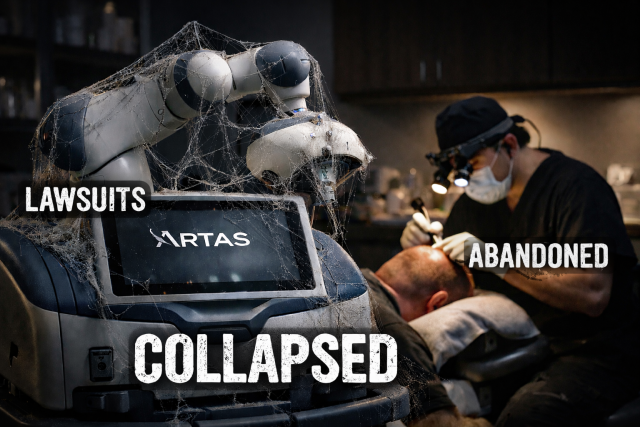

The Promise of a Robotic Future
When the ARTAS robotic FUE system was introduced more than a decade ago, it was heralded as a technological breakthrough. The narrative was compelling: hair transplantation, long dependent on surgeon skill and manual consistency, would finally be standardized through robotics. By using imaging, algorithms, and robotic precision, ARTAS promised to reduce variability, improve accuracy, and scale FUE in a way that human hands supposedly could not. For investors and clinics alike, robotic FUE appeared to be the inevitable next frontier.
Why the Vision Fell Apart Clinically
Hair transplantation, however, is not an assembly-line procedure. Follicles exit the scalp at variable angles, curve beneath the skin, and differ dramatically between patients and even within the same donor area. While the ARTAS robot could perform adequately in select cases, it struggled with the biological variability that defines real-world patients. Depth control, angle adaptation, and tactile feedback—critical elements in minimizing transection—remained areas where experienced human operators consistently outperformed the machine.
As the field matured, elite surgeons refined manual FUE techniques, rendering the robotic advantage increasingly irrelevant. Modern manual systems allow for precise scoring, excellent graft release, and low transection rates when performed by skilled teams. Importantly, these systems also use significantly smaller punch sizes than robotic platforms, preserving donor aesthetics and reducing long-term scarring. With these advances, the clinical justification for robotic extraction steadily eroded.
Business Reality and Legal Consequences
The gap between marketing promises and clinical reality eventually spilled into the business side. Restoration Robotics, the company behind ARTAS, faced investor scrutiny and securities class action litigation arising from disclosures regarding its technology and business performance. While the case ultimately settled, it marked a turning point in how robotic FUE was perceived—not as a disruptive force, but as an overpromised solution struggling to gain sustainable traction.
The company later merged with Venus Concept, a move widely interpreted as a reset rather than a validation of ARTAS as the future of hair restoration. By that point, the industry had largely moved on.
Who Uses Robotic FUE Today—and Who Doesn’t
One of the clearest signals of ARTAS’s limitations is who does—and does not—use it today. The world’s most respected hair transplant surgeons overwhelmingly rely on manual FUE, performed by highly trained teams with refined tools and protocols. These surgeons value adaptability, judgment, and control over automation.
In contrast, robotic systems are more commonly adopted by non–hair transplant surgeons or novice clinics seeking a shortcut into offering FUE. For these practices, the robot serves less as an innovation and more as a substitute for experience. That distinction matters, because hair transplantation is ultimately a craft, not a commodity.
The Real Lesson of Robotic FUE
ARTAS did not fail because robotics have no place in medicine—it failed because hair restoration cannot be reduced to automation alone. The most critical aspects of successful outcomes—patient assessment, donor management, hairline design, graft handling, and placement strategy—remain fundamentally human. Technology can assist, but it cannot replace surgical judgment.
A decade later, robotic FUE stands as a case study in the limits of automation within a biologically complex, artistically driven surgical field. The future of hair transplantation was never robotic—it was, and remains, skilled hands guided by experience.
Will Robotic Hair Transplantation Exist in the Future?
Robotic hair transplantation is unlikely to disappear entirely, but its role will remain limited unless there is a fundamental shift in how the technology integrates with surgical judgment. Future systems may improve imaging, AI-assisted follicle mapping, or decision-support tools that help surgeons plan extractions more efficiently. However, fully autonomous hair transplantation is improbable. The variability of human anatomy, differences in hair caliber and curl beneath the skin, and the need for real-time tactile feedback make complete automation unrealistic. If robotics returns meaningfully to hair restoration, it will likely function as an assistive technology in the hands of expert surgeons—not as a replacement for them. The future, if it exists, will be collaborative rather than robot-driven.