




Procedure detail
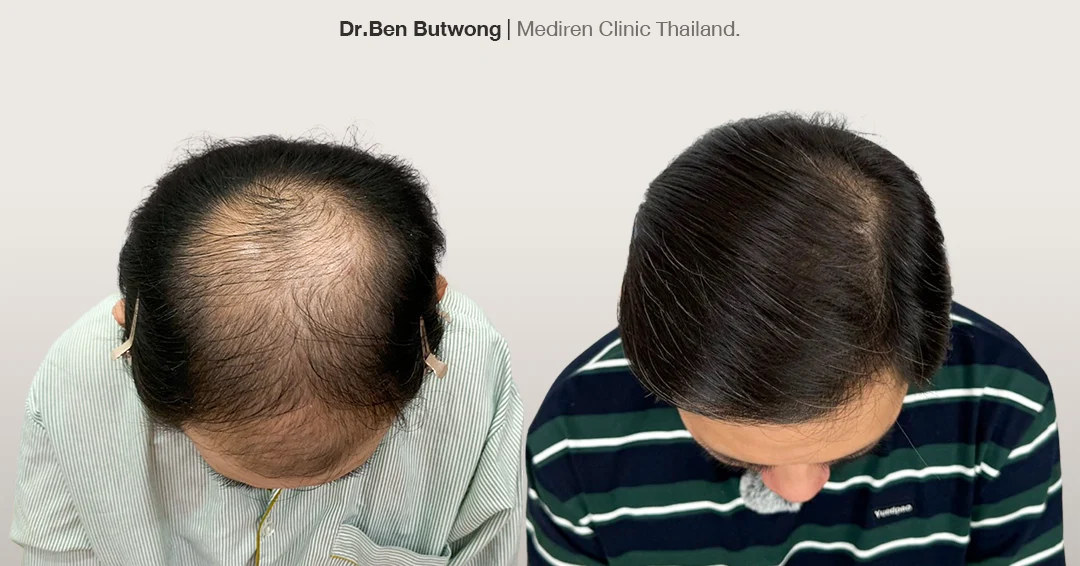
This 40-year-old male patient had been experiencing progressive hair thinning since the age of 25, eventually developing significant hair loss from the frontal area through the mid-scalp and crown.
He had straight hair with good donor density, which allowed us to plan a broad restoration while still respecting long-term donor preservation. In this case, the focus was not only on coverage, but also on precision, accuracy, and recipient-site planning — including appropriate graft distribution, natural direction, angle, and density transition from the frontal zone to the crown.
A key part of this case was the crown design. The recipient sites were carefully created to follow the natural rotational pattern of the crown, allowing the transplanted hair to blend smoothly with the surrounding native hair and create a more natural visual flow.
For the hairline, the design was planned according to this patient’s facial structure, cranial contour, ethnicity-related aesthetic characteristics, and personal preference. Asian patients may have different skull curvature, facial proportions, and preferred hairline shapes compared with many Caucasian patients. As surgeons, our role is not to impose one fixed concept of an “ideal” hairline, but to arrange the grafts with medical precision so that the final result remains natural, balanced, and aligned with the patient’s individual identity.
This case shows a patient-preferred hairline approach with careful graft placement and refined overall planning. For those who would like to see a different style of irregular hairline design, please refer to my previous 6,000-graft megasession case.
At the 1-year follow-up, the result demonstrates good front-to-crown improvement, natural crown orientation, and a well-preserved donor appearance — an important part of responsible long-term hair restoration planning.
Bald class
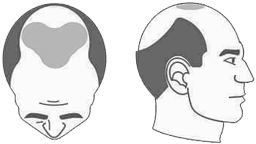
Norwood stage 6
The balding areas at the temples join with the balding area at the vertex. The band of hair across the top of the head is gone or sparse.