




Procedure detail
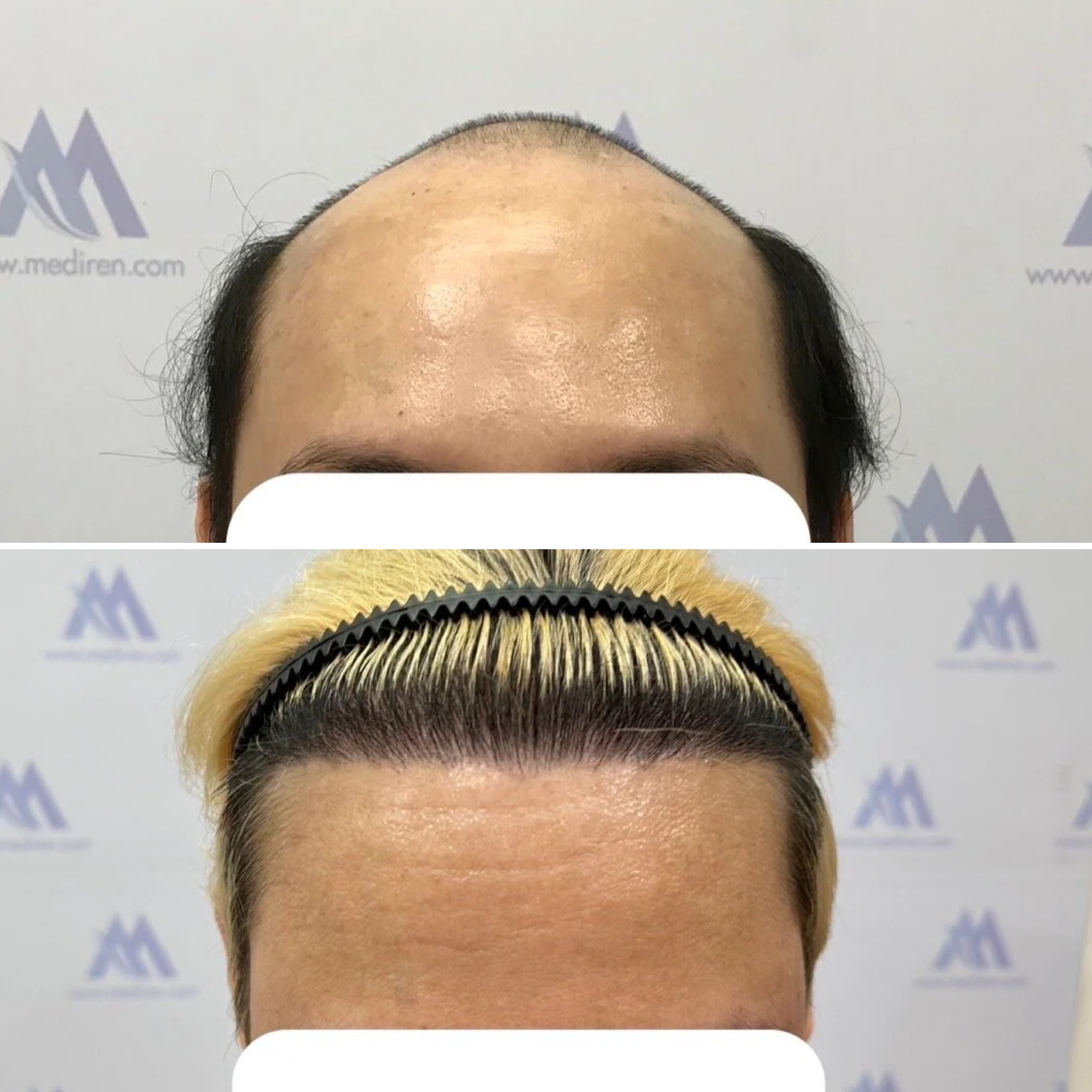
This 40-year-old male patient had been wearing a wig for more than 10 years. On clinical examination, the recipient scalp appeared thin and delicate, likely influenced by long-term wig attachment and adhesive use. He also had very fine hair caliber, while the occipital donor area showed relatively favorable density.
The hair loss involved a broad area from the frontal zone through the mid-scalp and crown. He had never undergone previous hair-loss treatment and declined medical therapy after counseling, so the surgical plan required careful donor management and realistic long-term planning.
The restoration was performed in two stages. The first session was a 5,000-graft FUE procedure to restore coverage from the frontal area to the crown. A second FUE session was later performed to lower the hairline by approximately 1 cm and further refine the frontal frame.
This case highlights the importance of strategic graft distribution, recipient-site precision, and donor preservation in a high-demand case with fine hair and a large balding area. The goal was not only to create visible density, but also to maintain a natural overall balance between the transplanted area and the donor region.
The photos show the result 12 months after the second procedure, demonstrating improved front-to-crown coverage, a stronger facial frame, and a donor area that remains well blended and cosmetically harmonious after two surgical sessions.
Bald class
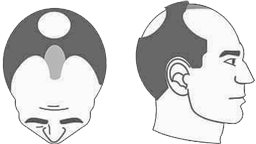
Norwood class 4
Characterized by further frontal hair loss and enlargement of vertex, but there is still a solid band of hair across the top (mid-scalp) separating front and vertex.