





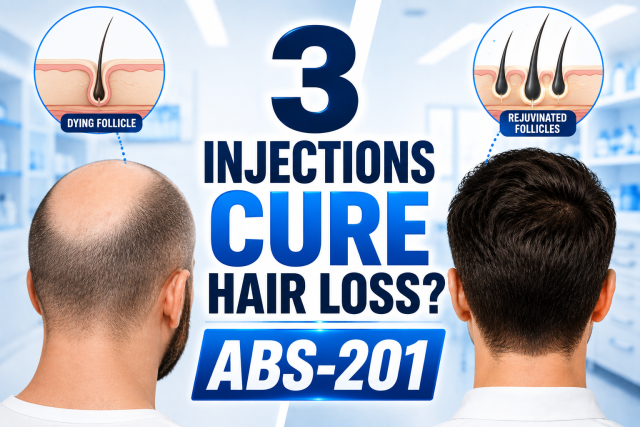

For decades, the treatment of androgenetic alopecia has largely revolved around the same medications. Minoxidil has been used to stimulate hair growth, while finasteride and dutasteride target DHT, the hormone primarily responsible for male pattern baldness. For those who have already lost significant amounts of hair, hair transplant surgery remains the only proven way to physically restore hair to areas that have become bald.
But a new experimental treatment called ABS-201 is taking a completely different approach to hair loss, and it has now entered human clinical trials.
Developed by biotechnology company Absci, ABS-201 is an experimental antibody designed to block the prolactin receptor, or PRLR. Rather than reducing DHT, ABS-201 aims to interfere with a biological signal that researchers believe helps regulate the hair growth cycle.
Perhaps the most interesting part of ABS-201 is how infrequently it may need to be administered.
Early human data suggest that ABS-201 has a half-life of at least 65 days. Based on these results, researchers believe it may eventually be possible to administer ABS-201 only two or three times during a six-month period.
In other words, a future hair loss treatment could potentially involve receiving an injection every few months instead of taking a pill or applying a topical treatment every day.
Could three injections actually cure hair loss?
We aren't there yet.
ABS-201 remains experimental, and researchers still need to prove that it can produce significant hair growth in humans. But people with androgenetic alopecia are now receiving ABS-201 in a clinical trial, and the first proof-of-concept hair-growth results are expected in the second half of 2026.
What Is ABS-201?
ABS-201 is an investigational monoclonal antibody being developed to treat androgenetic alopecia, commonly known as male and female pattern hair loss.
Androgenetic alopecia is the most common form of hair loss worldwide. In men, it typically causes a receding hairline, thinning crown and eventually more extensive baldness. Women generally experience progressive thinning throughout the top of the scalp while retaining more of their frontal hairline.
Most existing treatments attempt to either stimulate hair growth or interfere with the androgen pathway responsible for follicle miniaturization.
ABS-201 is different.
It targets the prolactin receptor.
Prolactin is most commonly associated with reproductive biology and lactation, but research suggests that prolactin signaling also plays a role in the biology of human hair follicles.
Hair follicles continuously cycle between different stages.
Anagen is the active growth phase, during which the follicle produces a hair shaft. Catagen is a short transitional phase when growth stops and the follicle begins to regress. Telogen is the resting phase before the cycle eventually begins again.
Researchers believe prolactin receptor signaling can influence this process and promote the transition of follicles away from the active growth phase.
ABS-201 is designed to block that signal.
The theory is that interfering with prolactin receptor signaling could help follicles remain in the growth phase longer and potentially influence some of the biological processes associated with hair follicle miniaturization.
This is important because ABS-201 isn't simply another version of finasteride or minoxidil. It represents an entirely different approach to treating pattern hair loss.
Can ABS-201 Reverse Hair Follicle Miniaturization?
This is what makes ABS-201 particularly interesting.
Androgenetic alopecia doesn't normally cause a healthy terminal hair to disappear overnight. The follicle gradually miniaturizes.
A thick terminal hair becomes progressively thinner and shorter with each successive hair cycle. Eventually, the follicle may produce a tiny, almost invisible hair.
If ABS-201 can meaningfully interfere with that process and restore miniaturized follicles, it could have significant implications for treating androgenetic alopecia.
Absci has conducted experiments using human scalp tissue outside of the body. The company says its research suggests blocking prolactin receptor signaling may prolong the anagen growth phase and influence biological factors involved in maintaining healthy hair follicles.
The company has also reported evidence suggesting that treatment could potentially help shift miniaturized follicles toward producing larger terminal hairs.
That sounds extremely promising.
However, anyone who has followed hair loss research for long enough knows that promising laboratory results don't always translate into impressive results on a human scalp.
There is a massive difference between showing that a biological mechanism works in cultured human follicles or an animal model and demonstrating that a treatment can visibly restore someone's hair.
That is why the current human trial is so important.
ABS-201 Human Trials Are Underway
The HEADLINE clinical trial began in December 2025 and is evaluating ABS-201 in healthy adults with and without androgenetic alopecia.
The randomized, double-blind, placebo-controlled Phase 1/2a study is expected to enroll up to 227 participants.
Researchers initially administered single intravenous doses of ABS-201 to healthy volunteers at several different dose levels.
In June 2026, Absci released interim results from 32 participants in these single-dose cohorts.
The company reported that the study medication appeared to be well tolerated across the tested doses. No treatment-emergent serious adverse events were reported in the interim analysis.
That allowed the trial to progress to the part that should be far more interesting to anyone suffering from hair loss.
Researchers are now administering multiple subcutaneous doses of ABS-201 to participants with androgenetic alopecia.
These are injections under the skin rather than the intravenous administration used during the initial portion of the study.
Researchers will be measuring actual changes in hair.
The clinical trial includes measurements such as target area hair count, target area hair width and changes in hair pigmentation. Investigators and patients will also assess whether hair growth has visibly improved.
These measurements should begin answering the question that ultimately matters.
Does ABS-201 actually regrow a cosmetically significant amount of hair?
Could ABS-201 Really Require Only a Few Injections?
The potential dosing schedule may be one of ABS-201's biggest advantages.
According to interim pharmacokinetic data released by Absci, ABS-201 has an estimated half-life of at least 65 days.
That means the antibody remains in the body for a relatively long period.
Based on these findings, Absci believes ABS-201 could potentially be administered two or three times over six months.
Compare that with the hair loss treatments available today.
Finasteride is typically taken every day. Oral minoxidil, when prescribed off-label for hair loss, is generally taken daily. Topical minoxidil has traditionally been applied once or twice per day. Other topical treatments require patients to apply medication to their scalp continuously.
That creates a problem that isn't discussed enough in hair restoration: compliance.
Hair loss treatment is usually a long-term commitment.
A medication might work, but it won't accomplish much if someone uses it inconsistently or stops treatment altogether.
If ABS-201 eventually proves capable of producing significant hair growth with only a handful of injections every year, the convenience alone could make it an attractive treatment.
But there is an important distinction between what is possible and what has actually been proven.
The current data suggest that infrequent dosing may be possible because of the drug's long half-life. We don't yet know what the optimal treatment schedule would be if ABS-201 eventually reaches the market.
More importantly, we still don't know how much hair it will grow.
How Is ABS-201 Different From Finasteride?
Finasteride has been one of the primary treatments for male pattern baldness for decades.
It works by inhibiting the 5-alpha-reductase enzyme responsible for converting testosterone into dihydrotestosterone, better known as DHT.
DHT binds to androgen receptors in genetically susceptible hair follicles. Over time, this process causes those follicles to progressively miniaturize.
ABS-201 does not work by lowering DHT.
Instead, it targets the prolactin receptor.
That raises an interesting possibility for the future of hair loss treatment.
Rather than having one medication replace another, we may eventually see treatments targeting several different biological pathways simultaneously.
One treatment could reduce the androgen-driven signal responsible for follicle miniaturization, while another influences the follicle's growth cycle.
Whether ABS-201 could eventually replace treatments such as finasteride or work alongside them is completely unknown at this stage.
First, it has to demonstrate meaningful hair growth in humans.
What Did ABS-201 Do Before Human Trials?
Researchers were interested enough in ABS-201 to advance it into human testing.
Absci previously tested the antibody in preclinical hair growth models.
The company reported that ABS-201 produced significantly greater short-term hair regrowth than topical 5% minoxidil in a mouse model.
Researchers have also studied the prolactin receptor pathway using human scalp tissue.
Those experiments provide evidence that blocking prolactin receptor signaling could influence the hair cycle and potentially encourage hair growth.
Again, this is encouraging, but it needs to be placed in context.
Hair loss research has produced countless treatments that looked incredible in mice.
Humans are what matter.
A treatment needs to produce enough terminal hair growth to create a visible cosmetic improvement. Adding a few hairs in a measured target area might technically demonstrate biological activity, but that doesn't necessarily mean patients are going to look dramatically different in the mirror.
The upcoming human data will therefore be far more important than anything we've seen from ABS-201 so far.
When Will We Know If ABS-201 Actually Works?
We may get our first meaningful answer relatively soon.
Absci expects to report interim proof-of-concept data from the HEADLINE trial during the second half of 2026.
Full proof-of-concept data are expected in early 2027.
Those results could make ABS-201 one of the most talked-about experimental hair loss treatments in years, or they could significantly reduce the current excitement surrounding the drug.
Hair counts will matter.
Hair diameter will matter.
Photographs will matter.
Most importantly, we want to know whether the improvement is cosmetically significant.
If ABS-201 can demonstrate meaningful terminal hair growth while requiring treatment only a few times per year, it would represent something genuinely different from the treatments we've relied on for decades.
Until we see those results, ABS-201 should be viewed as a promising experimental treatment, not a cure for baldness.
Can You Get ABS-201 Today?
No.
ABS-201 is an investigational treatment. It has not been approved by the FDA or other regulatory authorities for treating androgenetic alopecia.
Patients should be extremely skeptical of any clinic or website claiming to offer legitimate ABS-201 treatment.
At this point, the drug remains in clinical development.
Fortunately, patients suffering from hair loss today still have treatment options.
Medications such as finasteride and minoxidil can help many patients maintain their existing hair and potentially improve areas affected by miniaturization. Dutasteride is another medication commonly discussed within the hair restoration community, although its regulatory status for hair loss varies by country.
For men and women who have already experienced significant permanent hair loss, hair transplant surgery can restore hair to areas where medical therapy alone is unlikely to provide sufficient coverage.
However, the surgeon you choose matters tremendously.
Hair transplantation is permanent surgery. Donor hair is finite, and a poorly planned procedure can permanently waste grafts that can never be replaced.
If you're considering surgery, visit the Hair Transplant Network's list of recommended hair transplant surgeons. Our community has spent decades reviewing surgeons, surgical techniques and real patient results to help prospective patients make more informed decisions.
Follow ABS-201 and New Hair Loss Treatments
ABS-201 is one of several experimental treatments making this an unusually interesting period in hair loss research.
For decades, patients have largely had the same conversation about finasteride, minoxidil and hair transplantation. ABS-201 represents something different because researchers are targeting an entirely different biological pathway.
The possibility of treating hair loss with only a few injections per year makes the treatment even more intriguing.
But we shouldn't get ahead of the science.
ABS-201 has not been proven to cure hair loss. It hasn't even been proven yet to produce significant cosmetic hair regrowth in humans.
The next major milestone will be the human efficacy data.
Until then, the best approach is to follow the research without falling for the hype.
If you want to stay informed about ABS-201, emerging hair loss treatments, medications, clinical trials and hair transplant surgery, join the discussion on the Hair Restoration Network. Our community includes thousands of hair loss sufferers sharing treatment experiences, hair transplant journeys, and real results.
You can also subscribe to the Hair Restoration Network newsletter to receive updates on new hair loss treatments and important developments in hair restoration.
And if you don't want to wait years to see whether the next experimental treatment reaches the market, there are proven options available today.
Visit our list of recommended hair transplant surgeons to research physicians performing hair restoration surgery around the world, compare real patient results, and learn which surgeons may be worth considering for your own hair restoration.
Could ABS-201 eventually change the way we treat pattern hair loss?
Possibly.
Could a few injections per year actually restore significant amounts of hair?
That's the billion-dollar question.
For the first time, we're getting close to finding out.