





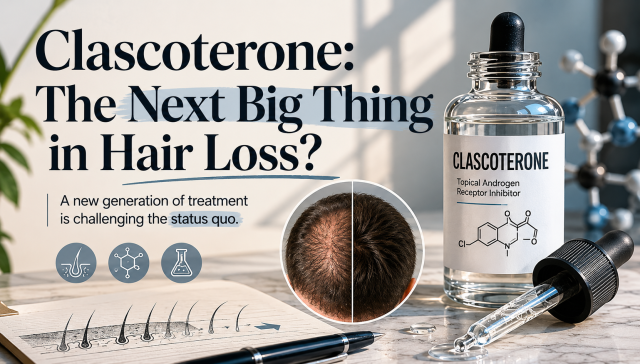

For more than two decades, the hair loss industry has largely revolved around two medications: finasteride and minoxidil. While both remain effective for many patients, neither is perfect. Finasteride can cause unwanted side effects in a subset of users, while minoxidil primarily acts as a growth stimulant rather than addressing the hormonal cause of hair loss.
Now, a new treatment is generating significant buzz among hair loss researchers and patients alike: Clascoterone, also known as CB-03-01, is being developed for hair loss under the name Breezula.
The question on everyone's mind is simple:
Could Clascoterone become the next major breakthrough in hair loss treatment?
What Is Clascoterone?
Clascoterone is a topical androgen receptor antagonist. In simple terms, it works by preventing dihydrotestosterone (DHT) from binding to androgen receptors within the hair follicle. DHT is the primary hormone responsible for androgenetic alopecia, commonly known as male pattern hair loss.
Unlike finasteride, which reduces DHT levels throughout the body, Clascoterone works locally in the scalp. The goal is to block DHT exactly where it causes damage while minimizing systemic exposure. Because the drug is rapidly metabolized after entering circulation, researchers believe it may avoid many of the side effects that concern some users of oral anti-androgens.
Interestingly, Clascoterone is not entirely new. A lower-strength version is already FDA-approved as an acne treatment under the brand name Winlevi. Researchers recognized its anti-androgen properties years ago and began investigating whether the same mechanism could help combat hair loss.
Why Is Clascoterone Different?
Most current hair loss medications fall into one of two categories:
Finasteride and dutasteride
- Lower DHT production
Minoxidil
- Stimulates hair growth
Clascoterone takes a different approach.
Rather than reducing DHT production, it blocks DHT from activating receptors within the scalp. Think of it as placing a cover over the lock rather than removing the key altogether.
This distinction is important because it enables targeting the root hormonal cause of hair loss without significantly altering hormone levels throughout the body.
For many patients who have been hesitant to use oral medications, that prospect is extremely appealing.
What Do the Clinical Trials Show?
For years, Clascoterone was viewed as a promising but unproven treatment. That changed dramatically in late 2025 and early 2026 when large Phase III studies reported positive results.
The SCALP-1 and SCALP-2 Phase III trials enrolled approximately 1,465 men with androgenetic alopecia. Researchers found statistically significant improvements in target-area hair count compared with placebo.
The headline numbers generated considerable excitement throughout the hair loss community. Company data reported relative improvements in hair counts ranging from 168% to 539% compared with placebo, depending on the study and endpoint analyzed.
Even more encouraging, follow-up data released in 2026 suggested the benefits continued to build with long-term use. Patients who remained on treatment for 12 months achieved significantly greater improvements than those who discontinued therapy after six months.
Researchers also reported a favorable safety profile. Across one year of treatment, Clascoterone demonstrated tolerability similar to placebo, with no significant systemic hormonal side effects observed.
Is It Better Than Finasteride?
This is where things become more complicated.
While the Phase III results are undoubtedly encouraging, Clascoterone has not yet been directly compared against finasteride in large head-to-head clinical trials.
Finasteride remains one of the most effective medical treatments ever developed for androgenetic alopecia. It has decades of real-world data supporting its use and consistently demonstrates strong long-term maintenance of existing hair.
At present, it would be premature to declare Clascoterone superior.
Instead, the more realistic question may be whether Clascoterone can become a valuable addition to the current treatment arsenal.
Many experts envision a future where patients combine therapies such as:
- Oral or topical finasteride
- Oral or topical minoxidil
- Clascoterone
- Hair transplantation when appropriate
In that setting, Clascoterone could become an important component of a comprehensive hair restoration strategy.
Will Clascoterone Be Approved?
The outlook appears increasingly positive.
Following successful Phase III studies, Cosmo Pharmaceuticals has indicated plans to pursue regulatory submissions. While approval timelines remain uncertain, the drug is now much closer to market than it was just a few years ago.
If approved, Clascoterone could become the first new mechanism of action for androgenetic alopecia in decades. That alone would represent a significant milestone in hair loss treatment.
Is Clascoterone the Next Big Thing?
The short answer is: possibly.
The longer answer is that Clascoterone may be one of the most promising hair loss medications currently in development.
The treatment targets the hormonal pathway responsible for androgenetic alopecia, has demonstrated positive Phase III results, is well tolerated, and offers a mechanism distinct from existing therapies.
However, it is important to maintain realistic expectations.
Clascoterone is unlikely to be a "cure" for hair loss. Instead, it appears poised to become another powerful tool for managing androgenetic alopecia. Much like finasteride transformed treatment options in the late 1990s, Clascoterone could potentially reshape the landscape for the next generation of patients.
Whether it ultimately becomes a blockbuster therapy will depend on long-term efficacy, real-world adoption, pricing, and its performance relative to established treatments.
But for now, Clascoterone has unquestionably earned a place among the most exciting developments in hair restoration.
Stay Ahead of the Latest Hair Loss Developments
The field of hair restoration is evolving rapidly. From Clascoterone and Pyrilutamide to stem cell therapies, hair cloning research, and the latest advances in hair transplantation, new developments emerge every year.
To stay informed, connect with thousands of patients, review real-world results, and learn about the world's leading hair transplant surgeons, join the Hair Restoration Network.
Whether you're researching medications, considering a hair transplant, or simply looking to stay current on emerging treatments, the Hair Restoration Network remains one of the most trusted resources in the hair loss community.
Visit the hair restoration network to keep up with the latest hair loss trends and learn from real patients who restored their hair and become part of the discussion today.