





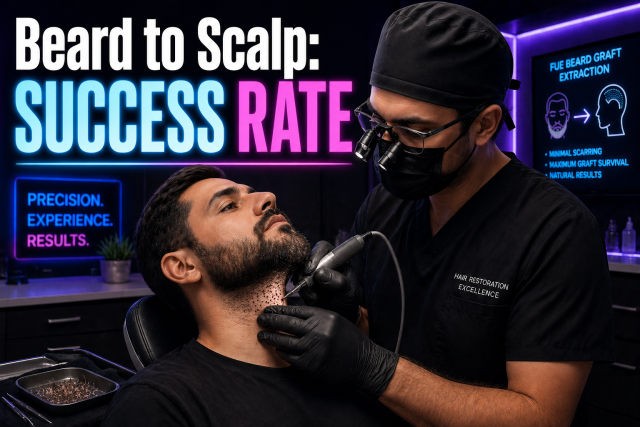

For years, beard hair was viewed as a fringe donor source, something reserved for patients requiring severe repair or those who had completely exhausted traditional scalp donor reserves. Today, that perception has changed dramatically.
Thanks to advances in Follicular Unit Excision (FUE), refined extraction techniques, and growing surgeon experience, beard-to-scalp hair transplantation has evolved into one of the most important innovations in modern hair restoration. What was once considered a “last resort” is now, in skilled hands, a powerful strategy for increasing donor supply, improving density, and helping patients with advanced hair loss achieve results once thought unattainable.
At the Hair Transplant Network, we’ve seen rising interest in beard grafts not only among repair patients but also in sophisticated combination cases where scalp and beard follicles are strategically blended to maximize coverage and visual density.
The question is no longer whether beard hair can work on the scalp.
It is how effectively it can be used—and in the right hands, the answer can be remarkably well.
Why Beard Hair?
The growing interest in beard donor hair is rooted in one simple fact: it can offer characteristics that meaningfully complement scalp hair.
Beard follicles—particularly from beneath the jawline and upper neck—often possess:
- Thicker hair shafts with greater caliber than scalp hair
- Strong visual density, especially in the mid-scalp and crown
- Excellent robustness and durability
- A potentially significant donor reserve, sometimes thousands of grafts in the right candidate
Unlike chest or body hair, beard hair is often much closer to scalp hair in texture and growth behavior, making it the preferred non-scalp donor source for many surgeons.
Many physicians now consider beard hair the gold standard of body hair transplantation.
And for good reason.
Impressive Success Rates
One of the biggest misconceptions surrounding beard-to-scalp transplantation is that beard grafts do not survive well once moved.
That concern has largely become outdated.
When harvested and implanted properly, beard graft survival can be excellent. Published reports and surgeon case series have suggested that survival rates can approach those of scalp grafts in well-selected cases, with rates often cited in the 80 to 95 percent range.
As with any transplant procedure, outcomes depend heavily on:
- Surgeon skill
- Punch size and extraction technique
- Graft handling and hydration
- Recipient site planning
- Proper patient selection
- Conservative donor management
But the outdated notion that beard grafts are unreliable or “second-rate” donor hair no longer reflects what many experienced surgeons are achieving.
In the right hands, beard grafting can be highly dependable.
Where Beard Hair Excels
Increasing Density in the Mid-Scalp
This may be where beard hair shines most.
Because beard follicles often have a larger diameter than scalp hairs, they can create a disproportionate visual impact.
Hair caliber matters.
Sometimes, thicker hairs can create the illusion of significantly greater density than a higher number of finer grafts.
That’s why some elite surgeons use beard grafts almost like “power fibers,” strategically layering them into the mid-scalp to boost fullness.
The effect can be surprisingly dramatic.
Crown Restoration
The crown can require a large number of grafts and often exposes donor limitations.
Beard grafts can help solve that problem.
Their caliber often performs exceptionally well in crown restorations, where bulk and coverage can matter more than the softness required in a frontal hairline.
For patients with advanced balding, this can be transformative.
Repair Cases
This is where beard-to-scalp transplantation may have had its greatest impact.
Patients with:
- Overharvested donors
- Poor previous surgeries
- Strip scars
- Depleted scalp reserves
often have limited options.
Beard hair has become a critical resource in many of these repairs.
Some of the most dramatic repair transformations in modern hair restoration have involved significant beard donor use.
Advanced Norwood Cases
Perhaps the most exciting application is what beard grafts have done for severe hair loss.
Historically, many advanced Norwood patients faced one unavoidable problem:
Not enough donor supply.
Beard hair helps change that equation.
By supplementing scalp reserves with thousands of additional grafts, some surgeons are pushing boundaries that once seemed unrealistic.
That has changed what may be possible for advanced patients.
Beard Hair Is a Supplement—Not a Replacement
This is where nuance matters.
Beard hair is not a substitute for scalp hair.
It is a supplement.
And placement matters enormously.
Hairline Design
Most elite surgeons avoid using beard hair in the leading edge of the hairline.
Why?
Because beard hairs are often:
- Coarser
- Wirier
- More robust than natural frontal singles
Used improperly there, they can appear unnatural.
Fine scalp singles remain the gold standard for softness and natural hairline design.
Strategic Blending Matters
Great surgeons do not simply “add beard grafts.”
They blend them.
This may be the biggest distinction between mediocre and elite use of beard donor hair.
Scalp follicles can provide softness and refinement.
Beard follicles can add caliber and density.
Together, they can create something neither could alone.
That is where artistry matters.
Does Beard Hair Behave Like Scalp Hair?
One of the most fascinating questions in body hair transplantation is whether beard hair changes after being transplanted to the scalp.
The answer appears to be partially.
Beard hair tends to retain many donor characteristics:
- Shaft diameter
- Curl tendency
- Some growth cycle traits
Yet many surgeons believe the scalp recipient environment may influence certain growth characteristics over time.
What matters clinically is this:
Beard hair can grow successfully on the scalp and contribute meaningfully to cosmetic outcomes.
That much has become increasingly clear.
Candidate Selection Matters
Not every patient is a beard donor candidate.
Ideal candidates often have:
- Dense beard growth
- Strong caliber follicles
- Good color and texture match
- Meaningful donor reserves under the jawline
- Limited scalp donor supply or need for supplemental grafts
Not every beard should be aggressively harvested.
Responsible surgeons treat beard donor management with the same seriousness as scalp donor management.
Overharvesting the beard can create cosmetic issues, too.
Done poorly, it can trade one problem for another.
Done skillfully, it can be an extraordinary resource.
The Rise of Combination Grafting
One of the biggest shifts in philosophy has been moving from beard hair as a “rescue option” to beard hair as part of a strategic donor blueprint.
This has given rise to combination grafting:
- Scalp hair for softness and naturalness
- Beard hair for density and support
This hybrid approach is increasingly where innovation is happening.
Many leading surgeons no longer view beard grafts as a backup plan.
They view them as part of the plan.
That is a major evolution.
What About Beard Donor Scarring?
Another common concern is scarring.
With modern small punches and proper technique, beard donor healing is often excellent and remarkably inconspicuous.
But, once again:
Technique matters.
Punch size matters.
Surgeon's judgment matters.
As always, donor management separates artistry from butchery.
Why Results Are Better Than Ever
Several developments have improved beard-to-scalp outcomes dramatically:
Better Extraction Technology
Smaller punches and refined FUE instrumentation have made harvesting safer and more precise.
Better Understanding of Placement
Surgeons better understand where beard grafts belong—and where they do not.
Better Patient Selection
Using beard donor hair in the right patients has improved consistency.
Better Strategic Planning
Perhaps most importantly, leading surgeons increasingly think in terms of lifetime donor management.
That has changed everything.
It’s Not Just About More Grafts
This is something many patients misunderstand.
The success of beard-to-scalp transplantation is not simply about adding more graft numbers.
It is about expanding donor resources intelligently.
That may mean:
- Enhancing density where scalp donor falls short
- Extending coverage in severe hair loss
- Repairing damage once thought irreversible
- Preserving precious scalp reserves
That is a very different philosophy from simply chasing large graft counts.
And often, that is where elite surgeons distinguish themselves.
Final Thoughts
Beard-to-scalp hair transplantation is no longer an experimental workaround or a niche option reserved only for difficult repair cases. In the right hands, it has become one of the most important innovations in modern hair restoration.
For patients with limited scalp donor reserves, advanced Norwood patterns, or a need for greater density, beard grafts can meaningfully expand what is surgically possible. Their caliber, robustness, and visual impact have made them a valuable adjunct, particularly when used strategically alongside traditional scalp donor hair.
That said, success with beard grafting is not simply about adding more hair. It depends on proper patient selection, conservative donor management, thoughtful placement, and a surgeon who understands how to blend beard and scalp follicles artistically and naturally. When those elements come together, outcomes can be remarkable. Some of the most impressive transformations seen today, particularly in repair work and high Norwood cases, owe part of their success to the intelligent use of beard donor hair.
As techniques continue to evolve and more surgeons refine their approach, beard-to-scalp transplantation is likely to play an even greater role in expanding the boundaries of what hair restoration can achieve. For the right patient, it may not just supplement a procedure. It may help make the procedure possible. To find a qualified surgeon who can successfully transplant beard hair to the scalp, review our list of vetted recommended surgeons.